
The Data Ownership Dilemma: Why CMOs Are Struggling to Execute Strategy
The Experimental Marketer Analysis of the latest PwC Survey

PWC's May 2025 Pulse Survey asked many C-Suite executives about a range of questions (including questions about the economy, changes brought by tariffs, etc. Its methodology is further explained below. There is also a link to the survey at the end of this article).
For this article, I will focus on CMO's answers in this survey, specially those that may touch in topics such as data, martech and internal marketing process misalignments.
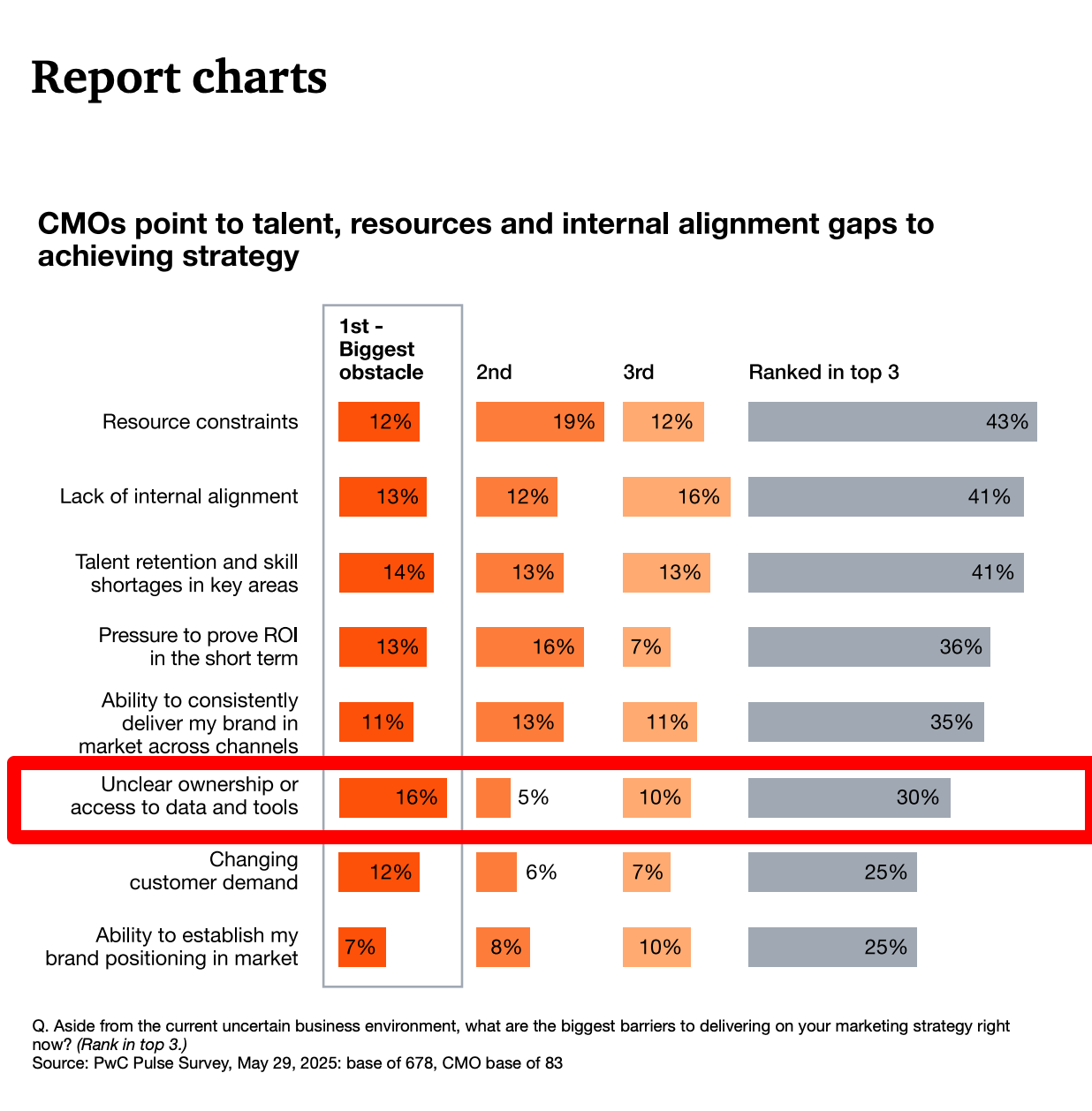
Here is what has gotten my attention: 30% of CMOs from Fortune 1000 companies rank "unclear ownership of data and tools" as a top barrier to executing marketing strategy. While marketing departments chase personalization and data-driven decisions, nearly one-third may be “blocked” by the a basic question: who actually owns the data they need?
This finding from PWC's May 2025 Pulse Survey seems to reveals a critical gap between marketing ambition and organizational reality. This is not without irony: companies are asking CMOs to deliver precision experiences while operating in organizationally chaotic environments, when it comes to data.
What's Really Happening?
The data ownership problem sits within a troubling lineup of barriers for CMOs: resource constraints lead at 43%, lack of internal alignment at 41%, and talent shortages also at 41%. But data ownership issues are particularly insidious because they can multiply every other challenge.
Another interesting piece of data: 82% of CMOs say one-to-one personalization isn't realistic right now . Unclear ownership or access to data and tools may be the biggest culprit here. This isn't a marketing, or even technology problem alone—it's fundamentally about organizational decisions and data governance.
The survey also reveals that while 92% of CMOs feel C-suite support for bold bets, they're hitting internal barriers that prevent strategies from becoming outcomes. In my experience, data ownership confusion usually sits at the heart of this execution gap.
Critical Questions That Matter
Why does this ownership gap persist when data is supposedly "the new oil"? One hypothesis is that companies accumulated data faster than they could establish clear ownership protocols, etc. This may have also led to the data silos that still exist in many companies (which starts a vicious cycle - as the company collects more data, the silos may grow, further complicating data ownership…)
What does this reveal about organizational maturity? There's a telling disconnect. CMOs are being asked to deliver sophisticated personalization while operating in organizationally immature environments. The survey shows 88% believe privacy rules complicate personalization, but internal barriers may be an even bigger obstacle.
How does this compound other challenges? Data ownership confusion can amplify every barrier. Resource constraints worsen when teams waste time navigating unclear data access. Talent shortages feel worse when skilled marketers spend time on data archaeology rather than strategy. Internal alignment becomes impossible when departments operate with different data definitions.
Survey Limitations and Reality Check
The PWC survey captured 83 CMOs out of 678 executives from Fortune 1000 companies between May 1-8, 2025. Key limitations to consider:
Sample bias: Larger companies might understate the problem compared to smaller, more agile organizations
Timing effects: Survey conducted during policy uncertainty, potentially inflating operational concerns
Definitional gaps: "Unclear ownership" versus "unclear access" require different solutions—ownership needs governance restructuring, access needs systems integration
These limitations suggest the 30% figure might represent the tip of the iceberg rather than the full scope when it comes to large enterprises (and should also apply to other company sizes as well).
The Path Forward
Reframe the Problem: Treat data ownership as enterprise governance, not just marketing or IT operations. Since 41% of CMOs cite "lack of internal alignment" as a barrier, data ownership confusion is often a symptom of broader organizational dysfunction.
Build Cross-Functional Solutions: Create data governance committees spanning marketing, IT, brand and finance.
Start Practical: Focus on "one-to-few" personalization experiences that require less complex data orchestration and small proof-of-concept projects. This helps builds governance capabilities while delivering meaningful customer experiences.
Measure Accessibility, Not Perfection: If marketing teams can access decision-making data within a reasonable, pre-defined period, perfect ownership structure matters less than functional access.
The data ownership dilemma isn't just a marketing challenge, it's also a test for organizational readiness in the digital age. Companies that solve this governance puzzle will have significant competitive advantage, while those treating it as a problem Martech alone can solve will find their CMOs perpetually frustrated, regardless of strategic acumen.
The question isn't whether an organization has data ownership issues—it's whether it can address them systematically rather than hoping they'll resolve themselves through slide deck presentations and better technology.
(Thanks to Keanu Taylor from The Martech Weekly for leeting me know about this survey)
(Below, a print screen from the survey, showing the CMO answer that first caught my attention)
_________________________________________________________________________
Thank you for reading!
Did you like this newsletter? Share it with a friend - they can sign up here
Want to read past newsletters? Click here
Learn more about the Experimental Marketer Framework