
Governance Translation: The Three Moves Senior Marketers Use to Get Promoted for Invisible Work
The governance work senior marketers do invisibly is the foundation of the evolving martech stack and every AI use case in marketing runs on.

This week we have The Experimental Marketer coverage of the latest State of Martech 2026 report, presented last May 5th.
My focus in this article is to help marketers understand what all these changes in the marketing technology landscape mean to them and their careers.
From all the wealth of information this report presents, one sentence from the report's webinar presentation stayed with me and sparked the main argument of this article.
Let me know your thoughts. Just reply to this email and we will get the convo going.
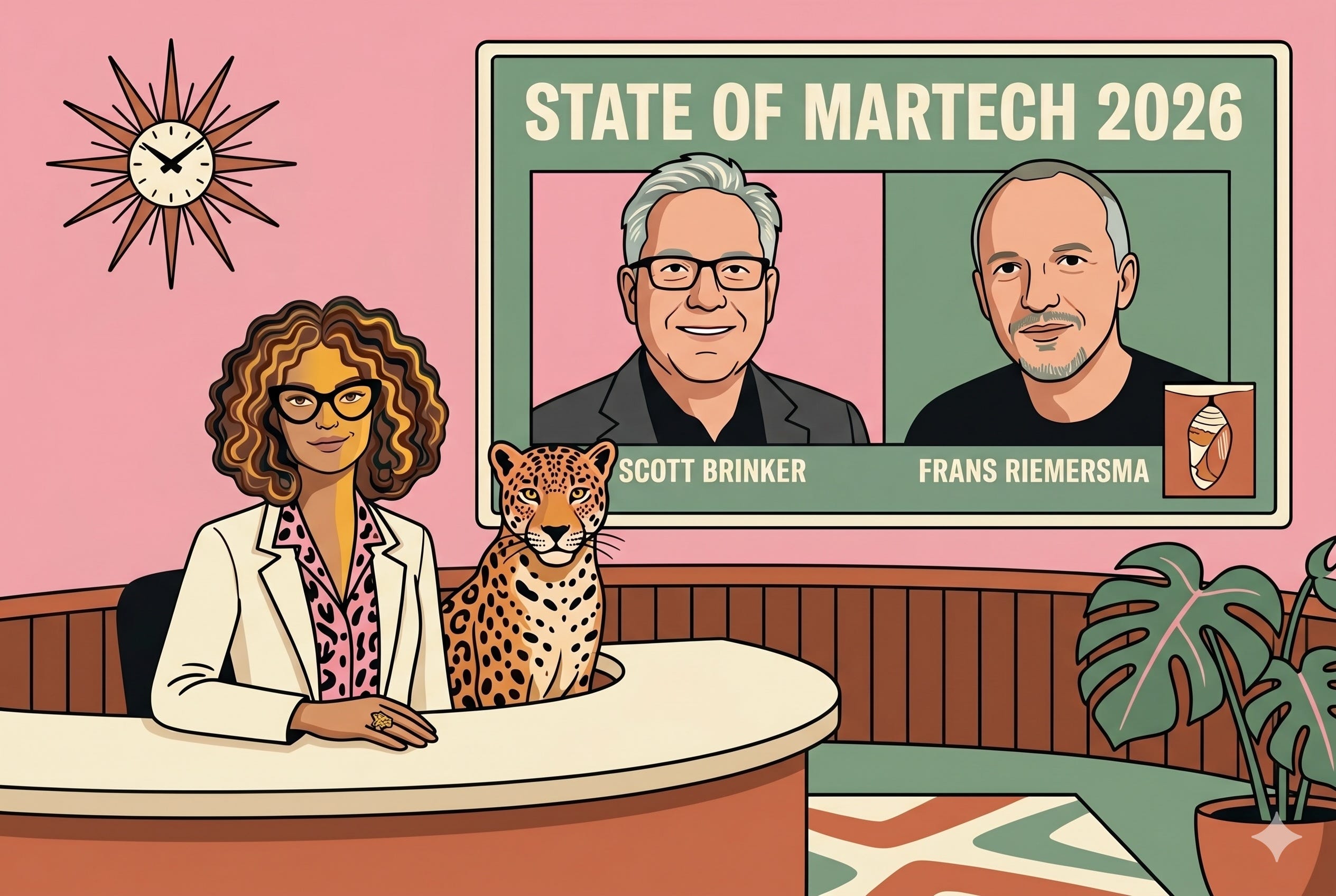
On May 5, Scott Brinker and Frans Riemersma walked several thousand marketers through State of Martech 2026. They covered the metamorphosis happening across marketing roles, the rebundling struggle inside the modern stack, the seventy AI use cases pulled from two hundred and eight respondents, the fifteen thousand five hundred and five products on the landscape map.
About forty minutes in, Riemersma said something quietly devastating.
They were on the slide showing how AI adoption splits across the trust ladder. Production use cases at the top of the trust list. Governance use cases at the bottom. Brinker described the gap. Riemersma added, almost as an aside:
“Yeah, nobody gets promoted for implementing a governance model.”
The line landed because every senior marketer in martech and marketing operations has thought about it before. Most have said some version of it to a colleague over coffee. Almost none have said it on the record.
He is right about what he said. But here, I will use my own experience and explain how this can change.
If you are reading this and the work you do every week is upstream of the campaigns, integrated into the data pipes, governing the consent flows, structuring the context the AI agents will eventually act on, Frans named your career problem. He did not name what closes it.
That part is what the rest of this article is about.
You are reading The Experimental Marketer Newsletter.
What you get: every week, one martech or AI concept broken down
with real examples, step-by-step walkthroughs, and the career case for why it matters.
Created by a Marketer, for Marketers.
Frans is right
He said it out loud, but the report itself spends most of page 35 making the same case. AI copy production sits at 91% adoption inside Content and Experience. Content Authenticity and AI Detection sits at 37%. In the data category, coding and automation use cases run between 75 and 83 percent adoption while Data Compliance and Governance is at 50 percent, Data Lineage at 49 percent, and Customer Privacy and Consent Management at 47 percent. Companies in the social category seem to be running agentic engagement experiments before the governance frameworks for those agents exist in any robust form. The same pattern appears across category after category.
The report names the structural reason clearly. Governance loses every budget conversation because there is no immediate ROI story. Nobody on the leadership team has a P&L line item that requires labeling AI-generated content or implementing metadata cataloging. The value of governance is usually seen as preventing a crisis that has not happened yet, which makes it perpetually next quarter’s problem. Brinker and Riemersma’s metaphor for this is one of the more memorable images in the report: everyone has learned to make the sausage with AI, almost nobody has bought a labeling machine.
I chuckled and nodded. Hard.
If Frans is right about the incentive structure, and he is, then a particular kind of senior marketer is structurally stuck. The marketer who spends Tuesday afternoon writing a consent flow that the legal team will eventually thank her for. The martech ops lead who quietly migrated the company off three duplicate vendors and reduced the data integration surface by thirty percent. The marketing director who built the AI use-case approval process that lets her organization move faster than its competitors precisely because nothing is going to blow up in their faces. Their work compounds for the company. Their performance review documents capture about ten percent of it. Their next promotion conversation does not mention it at all.
That is the trap Frans named.
The report does name something else. Just not the way out.
The metamorphosis trap
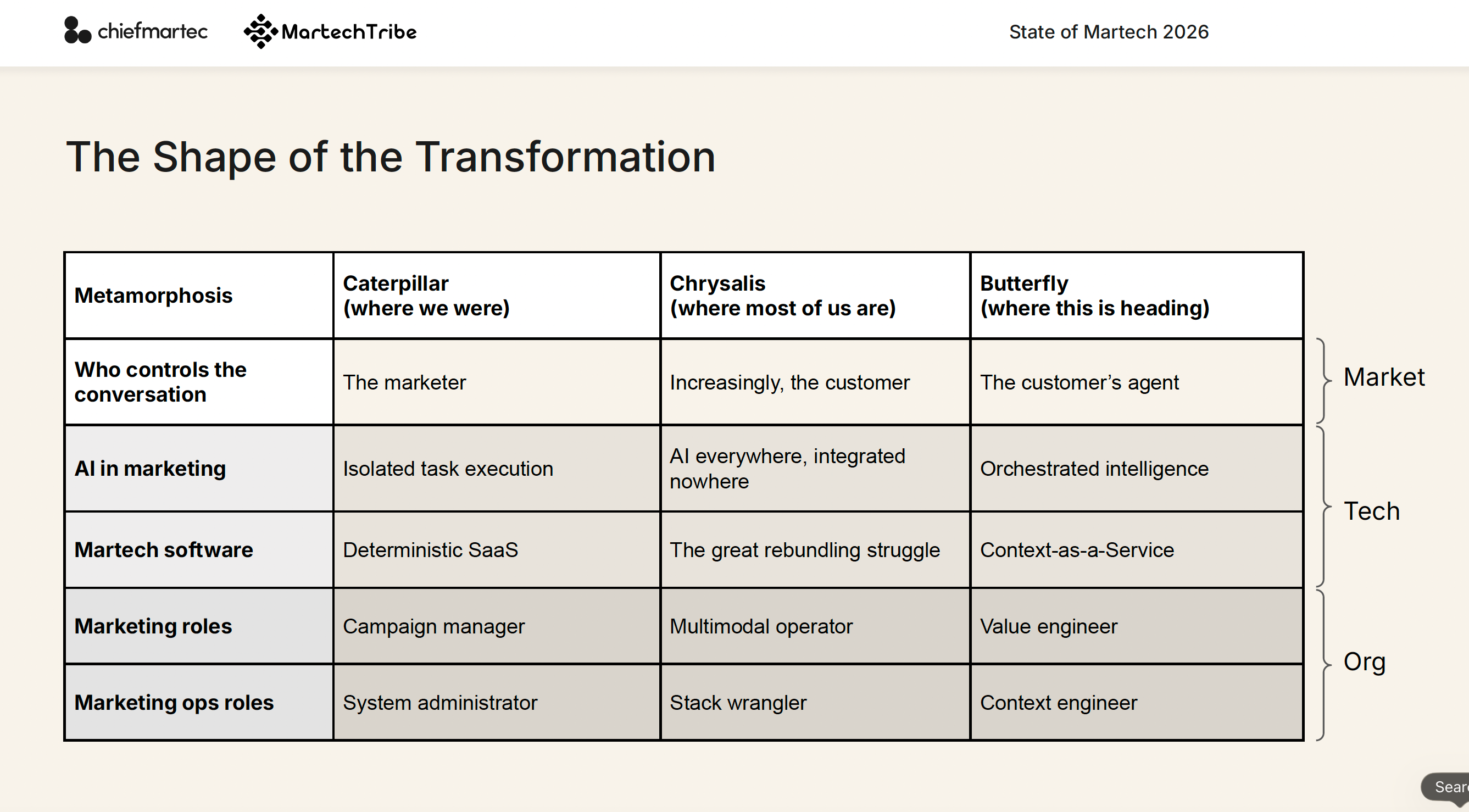
Brinker and Riemersma frame the current moment in marketing and marketing technology as a metamorphosis. Their report calls the destination value engineering and context engineering throughout the stack. They lay it out across two rows of a table that are worth dwelling on, because, in my opinion, they are doing more analytical work than the report’s prose around them gives them credit for.
The first row tracks marketing roles. Today’s senior marketer is a campaign manager. The chrysalis version is what the report calls a multimodal operator, the marketer juggling AI tools, legacy workflows, and an expanding surface area of channels. The destination is the value engineer, the marketer who designs systems that deliver measurable value across every customer interaction.
The second row tracks marketing operations roles. Today: system administrator. The chrysalis version: stack wrangler, stitching together SaaS, AI, and custom-built solutions, often held together more by improvisation than design. The destination: context engineer, orchestrating what data, content, tools, and instructions reach each AI agent at the right moment.
Read these rows together and the picture sharpens. The work the report is naming as the destination, value engineering and context engineering, is exactly the work most senior marketers in martech and marketing operations are already doing. Quietly. Under a different name. Without the recognition that comes with the new role names.
The title is not the promotion. The capability is. And the capability is invisible to the people who approve titles unless someone translates it.
McKinsey’s recent research on agentic AI in marketing makes the size of this gap concrete. Roughly nine in ten organizations have deployed generative AI in at least one part of the marketing function. About one in ten report meaningful enterprise-level value from it. The eighty-point gap between deployment and value is the same gap Frans named on the keynote stage. Companies that cannot translate this type of AI capability into business outcome capture none of the value. The marketers inside those companies who can translate are the ones whose careers move regardless of whether the company does.
Melissa Reeve’s analysis of the same dynamic puts it in stack terms. Over a thousand net-new AI tools were added to the marketing technology landscape in twelve months. The marketers who add tools to their stack are not the marketers getting promoted. The marketers who can stand in front of leadership and say what those tools deliver, in language leadership recognizes, are the ones moving.
The metamorphosis the report names is real. The skill that gets you across it is not in the report.
I was supposed to be stuck
Years ago, I was running global customer journey work for a Fortune 500 organization. The official scope of the role was customer experience strategy. The actual scope, in the same way most of you are reading this and recognizing your own job description, was about sixty percent governance work (and I did not realize that before starting in this role!). Data unification across more than twenty countries and eight languages. Consent management across regulatory regimes that did not agree with each other. A single customer view that required convincing the regional customer data owners to speak to the same identity model. The strategic CX outputs the organization wanted depended entirely on the governance infrastructure no one wanted to budget for.
What is needed here is translation of what governance can mean for business goals and marketing processes improvement.
That is the skill. Translation.

What translation actually looks like
Translation, in the sense I am using it here, is not the same as communication, and it is not a soft-skill euphemism for being likable in meetings. It is the discipline of turning the work the company depends on but does not see into the language the company has already agreed to fund.
There are three moves.
Lead with the benefit ledger, not the compliance ledger. Most governance documents start with what the work prevents. Risk avoided, fines avoided, regulatory exposure managed. These items are real, and they belong somewhere in the documentation. They do not belong on the first page of the document a VP is going to read. The first page of that document needs to be a list of what the work makes possible. The acquisition cost reduction the consent infrastructure unlocks. The campaign speed the unified identity model enables. The retention lift the cleaned-up customer profiles produce. Compliance belongs in a footnote. The benefits earn the headline.
Use the company’s success language, not the martech community’s. The phrases “context engineering,” “data lineage,” “consent orchestration,” and “agent governance” are accurate technical descriptions of work that is happening in your organization right now. None of them are language any VP or senior leader outside marketing operations recognizes as a promotion-worthy outcome. The substitution work is not subtle and it does not require dumbing anything down. Brinker’s keynote slide titled “Reverse-engineer your revenue” lists three questions: who is your biggest customer, what do they buy most, what is the margin. The slide notes that most marketers cannot answer them. The translation of context engineering into the language a VP funds is some version of “we can answer those three questions tomorrow morning, without two analysts and a week, because of the work my team has done.” That is the same work. It is the language that gets it funded.
Make the governance invisible inside the outcome. This is the move most senior martech people may resist, because the work itself feels like the point. The outcome is the point in a promotion conversation. The plumbing should be load-bearing and out of sight. If your VP is asking you about the plumbing in the second meeting, the translation has not landed yet.
Ronald Gaines, in a recent Humans of Martech episode with Darrell Alfonso, names a six-skill framework for marketing operations leaders that maps directly to what these three moves require. Influence without authority. Self-defined scope. Minimum viable discipline. Product mindset. Data stewardship. Intake design. Read those skills in order and you are reading the operating system of someone who has already learned to translate. Influence without authority is what produces the benefit ledger. Product mindset is what substitutes the company’s success language for the martech community’s. Self-defined scope is what lets a senior martech leader put the governance below the surface and lead with what it produces.
The Gaines framework names the capability. The State of Martech 2026 report names the destination. What sits between the two is the translation skill, the move from doing the work to communicating it in the form that produces a promotion.
In my own experience, the hardest part is using the company’s business language to describe such technical aspects of how marketing works. Hence, the many analogies used when writing and talking about martech (like the chrysalis analogy mentioned above).
For the CMO reading this
If you are a CMO reading this article and wondering why your governance team is invisible to the rest of your organization, the answer is partly inside what your organization rewards. The structure Frans named is operating in your house, not just in the industry abstract.
The ANA Martech Playbook for CMOs (full disclosure: I am a contributor), makes a point about marketing operations and martech roles that has not aged. The argument is that these are increasingly the load-bearing roles inside the modern marketing organization, and they are also the roles most underinvested in. The Playbook frames this as a forecasting risk. Underinvested governance roles produce a marketing organization that cannot scale into the AI era no matter how much technology budget the CMO secures.
The move is to build translation into the job description, not on top of it. Promote on what the governance enabled, not on whether the governance was implemented. Pay for outcome capture, not just outcome production.

Where this leaves you
Frans Riemersma was right. Nobody gets promoted for implementing a governance model.
He was right about the system as it operates by default. He was right about the incentive structure. He was right about what most companies value when they design promotion criteria, and what they fail to value when the work is plumbing rather than performance.
He was right about all of that. He was not right about you. With the work you are already doing, in the next quarterly review you have already scheduled, the system Frans named bends.
The marketers who get promoted in 2026 for invisible work are the ones who learned to translate it. Not into a different kind of work. Into a different kind of language. The work the report calls value engineering and context engineering is the work senior martech and marketing operations leaders have been doing for years. The piece of the future State of Martech 2026 does not draw is the bridge between doing the work and being recognized for it. That bridge is governance translation.
I wrote a book about the eight skills strategic marketers need now. The first one is Explore, the strategic discovery skill the report calls value engineering and features an exclusive interview with Scott Brinker about the future of marketing work. Translation runs through the whole framework. My book “Strategic Marketing Skills: How to build technology-driven expertise that delivers business value” will be published in October (from Kogan Page publishing).
Sources
Brinker, Scott, and Frans Riemersma. State of Martech 2026 (keynote presentation). chiefmartec & MartechTribe, May 5, 2026. Sponsored by GrowthLoop, Hightouch, Knak, MoEngage, Pega, Progress, and SAS. The “nobody gets promoted for implementing a governance model” quote is from Riemersma during the live keynote.
Brinker, Scott, and Frans Riemersma. State of Martech 2026 (full report). chiefmartec & MartechTribe, May 5, 2026. Sponsored by GrowthLoop, Hightouch, Knak, MoEngage, Pega, Progress, and SAS. Source for the page 35 governance gap statistics, the metamorphosis table covering marketing roles and marketing operations roles, the “value engineering” and “context engineering” framing, the “Reverse-engineer your revenue” slide, and the sausage-and-labeling-machine metaphor. Available at chiefmartec.com.
Esber, Deepika, Eric Stein, Julien Boudet, Kelsey Robinson, and Nayan Shah. “Reinventing Marketing Workflows with Agentic AI.” McKinsey & Company, April 21, 2026. https://www.mckinsey.com/capabilities/growth-marketing-and-sales/our-insights/reinventing-marketing-workflows-with-agentic-ai. Source for the gen AI paradox: roughly 90 percent of organizations have deployed generative AI in marketing, fewer than 10 percent capture meaningful enterprise-level value across end-to-end workflows.
Reeve, Melissa. “AI Moved Forward, Marketing Did Not.” MarTech (martech.org), early May 2026. https://martech.org/ai-moved-forward-marketing-did-not/. Source for the kudzu AI metaphor and the over-1,000 net-new AI marketing tools data point. Reeve is the creator of the Hyperadaptive Model and author of Hyperdaptive: Re-wiring the Enterprise to Become AI-Native.
Gaines, Ronald (with Darrell Alfonso). “6 Things the Next Generation of Marketing Ops Leaders Must Learn.” Humans of Martech podcast, Episode 210, March 10, 2026, hosted by Phil Gamache and Darrell Alfonso. https://humansofmartech.com/2026/03/10/210-ronald-gaines-6-things-next-gen-mops-must-learn/. Source for the six-skill framework for marketing operations leaders: influence without authority, self-defined scope, minimum viable discipline, product mindset, data stewardship, and intake design. Gaines is Senior Manager of Martech and Data Analytics at Sunbelt Rentals.
Association of National Advertisers. The CMO’s Playbook for Marketing Technology (ANA, March 2025). https://www.ana.net/miccontent/show/id/rr-2025-03-playbook-cmo-martech. Source for the framing of marketing operations and martech roles as load-bearing and underinvested inside the modern marketing organization. The author of this article participated in the development of this Playbook as a volunteer member of the ANA AI and Martech Committee.
Mourão, Ana. Strategic Marketing Skills: How to Build Technology-Driven Expertise That Delivers Business Value. Kogan Page, forthcoming October 2026. The book features an exclusive interview with Scott Brinker on the future of marketing work in Chapter 1 (Explore).
Interesting. Thanks for sharing