
Execution Was Repriced to Zero. The Barbell Is How Your Marketing Career Thrives With It.
Or how to create an antifragile system for your career, too

For this newsletter, I wanted to get Taleb's antifragile concept that I used to describe resilient and adaptable marketing systems in my book, but turn it towards the Marketer's own career.
I build and reconfigure my own Marketing Career Barbell constantly. It is an never ending process, I am afraid!
I hope this helps you as it has been helping me. Just hit reply and let me know yrou experience and thoughts. Let's get this convo going!
Best, Ana
A marketing team takes four days to turn a blog post into an email newsletter. Every person on that team now works with AI, and each of them is roughly 30 percent faster at their own task. The newsletter still takes four days. The handoffs are still human, the waiting periods between people are still very human, and the approvals are still human.

That gap between individual speed and organizational speed is the most useful thing to understand about this moment. The price of producing marketing work fell close to zero. The (very human) systems that carry the work from one person to the next did not change at all.

What actually got cheaper
Scott Brinker separates marketing activity into three layers. Creative and strategy sit at the top, historically small in headcount and hours. Marketing operations and technology sit at the bottom, holding the data plumbing. Between them sits production and analysis, the layer where most marketing budgets and most employee hours have always gone.
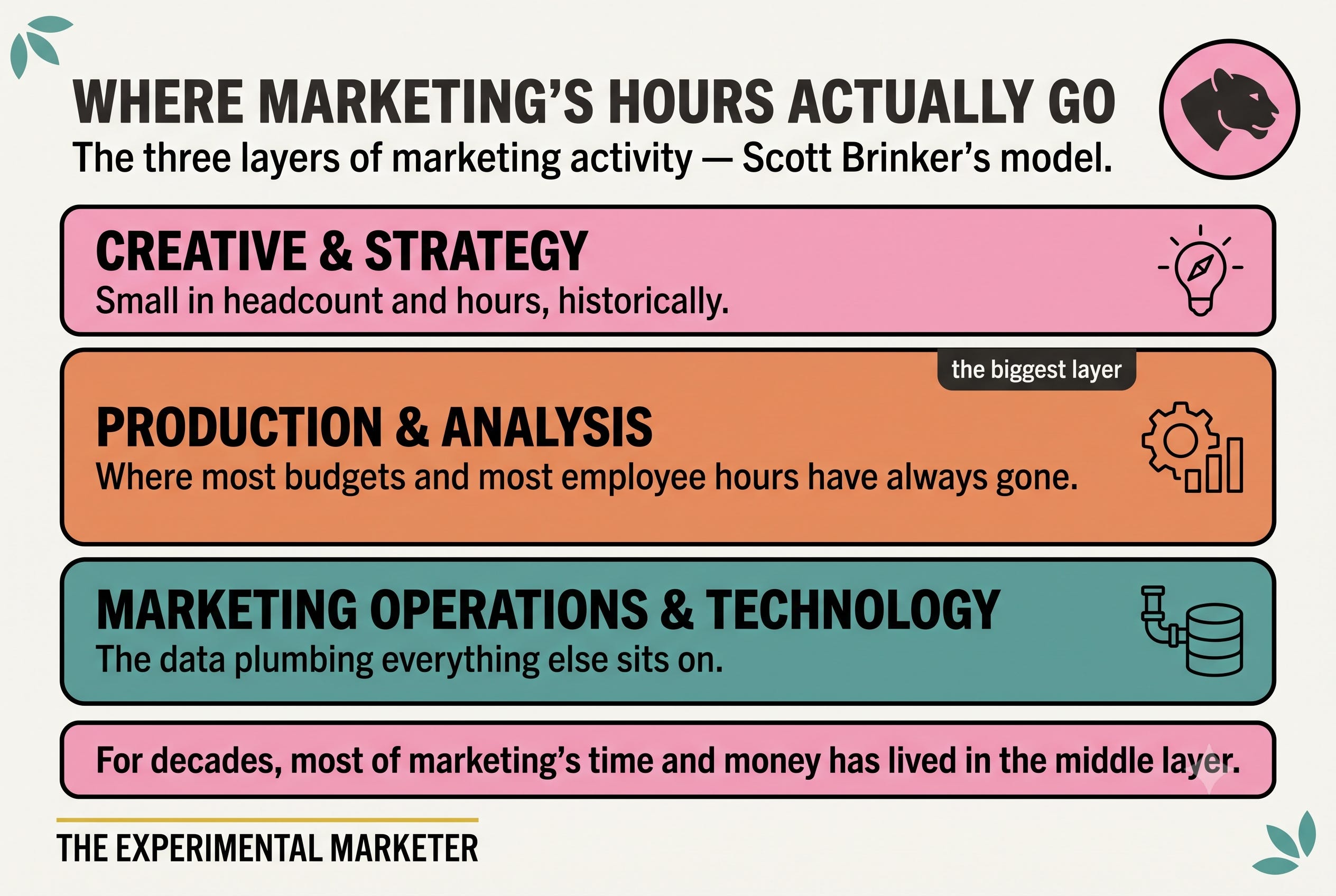
AI is hollowing out that middle layer. Formatting assets, drafting copy, building the deck, pulling the report. Those were the tasks that filled the calendar of a competent mid-career marketer, and they now can take minutes.
The promotion that did not arrive
The consensus reading of can sound somehow comfortable (at least to some). Execution becomes cheap, marketers move up into strategy, and the profession gets more valuable. Harvard Business Review describes the role moving from campaign manager to director of work, going from output to judgment.
That transition is real for some people and it has not arrived for most. Three things can get in the way.
The first is preparation. A marketer who spent a decade being excellent at execution may have never been asked to assess pricing, distribution economics, or even whether a segment was the right segment. This strategic view can be new and maybe nobody trained for it.
The second is arithmetic, and it is the one almost nobody accounts for. The hours that AI returned did not stay returned. They went into checking. One analysis of the martech stack puts it directly: if a human approves every AI output before it ships, the draft was automated and the bottleneck was kept, and within two quarters the AI has created more correction work than it removed. Senior review is the expensive part. As Laiba Tariq of InnReg puts it, the tool is cheap and the strategist who has to rewrite the output before it reaches a customer is not.
The third is authority. Marketing leaders increasingly carry accountability for technology decisions that were made by finance, IT, or a consultancy before marketing was in the conversation. Being handed time is not the same as being handed a decision.
You are reading The Experimental Marketer Newsletter.
What you get: every week, one martech or AI concept broken down
with real examples, step-by-step walkthroughs, and the career case for why it matters.
Created by a Marketer, for Marketers.
Strategy needs something underneath it
There is a version of this upward, strategic move that fails even when the marketer is capable and the time is actually given back. It fails because the data used to guide the discussion or the test is wrong, or is fine but answers a different question than the one being asked.
The numbers on this are not close. Gartner puts the annual cost of poor data quality at around 12.9 million dollars per organization. In my own research for my book, I found that 43 percent of organizations name data quality and readiness as their single largest obstacle to AI success, ahead of budget, talent, and the technology itself, while just 49 percent of the tools in the average stack are actively used. Roughly 14 percent of enterprises have achieved the unified customer view that more than 80 percent say they want.
Judgment built on that foundation is opinion wearing a deck. Brinker’s formulation of what AI changed is worth holding onto: it does not eliminate constraints, it moves them.
The barbell
Nassim Nicholas Taleb’s barbell describes a system that puts weight at two extremes and refuses to buckle at the middle. One end holds the safe and durable position. The other end holds small, aggressive, high-optionality bets. The medium-risk middle looks prudent and quietly carries the risk nobody figured out yet. Systems built this way improve under stress rather than merely surviving it, which is what Taleb calls antifragile.
Marketing careers are being forced into that exact shape. The durable end is the foundation: what the data means, how it moves, who governs it, and what the business is actually trying to do. The optionality end is judgment: what deserves to be built, what should be tested, what should be refused. The middle, which is production and analysis, is the part being repriced to nothing.
I call it the Marketer Career's Barbell.
Independently, brand strategists arguing that the standalone CMO role is being redesigned end up reaching the same shape, describing a barbell of technical systems fluency at one end and renewed consumer intimacy at the other. Their prescription may also conveniently resembles the product they sell, but the underlying observation still holds.
Read against the eight Es of my Experimental Marketer Framework, the barbell is more specific. The eight Es are the capabilities my book is built on, and they split across the two ends.
Two of them build the durable end of the barbell. Explore is seeing your data, your stack, and your customer as they actually are, not as a vendor or agency described them last quarter. Exchange is the governance that lets that data move across teams without losing its meaning. Together they are the foundation: what the data means, how it moves, and who owns it.
Two more build the optionality end of the barbell. Experiment is running structured tests that produce real insight, not just a number you can present in a deck. Everything is connecting marketing back to the business in the language other stakeholders use, so you know which bets are worth making. Together they are judgment: what deserves to be built, tested, or refused.
The last two keep both ends of the barbell alive over time, you need a solid foundation. Explain is making your thinking legible to the people whose support you need. Evolve is building judgment that outlives any single tool. Skip these two and even a strong foundation and sharp judgment can quietly erode, because no one understood them and nothing adapted. (The two I haven’t listed yet hold it together: Embrace, the chapter this idea lives in, is the barbell itself, and Engage, the buy-in to attempt any of it, runs underneath all four.)
The move that makes both ends reachable
Both ends of the barbell require the same underlying capability, which is the ability to see marketing as one system instead of a sequence of campaigns.
This is not a preference. Applying AI to disconnected, campaign-specific tools automates the disconnection, producing several separate algorithmic brains that do not talk to each other. Sangeet Paul Choudary compares treating AI as a faster way to do existing campaign tasks to early factories that treated electricity as a better way to spin the same central drive shaft. The machine changed while the floor plan did not.
This means expanding the campaign/promotions mind frame. From creating individual promotional campaigns to creating a content supply chain that fuel these campaigns, for example.
Marketers must see their own activities as part of a bigger system that is powered by technology in different shapes. Otherwise, there can be no systemic view of marketing, even with the best platforms in place.
What to do with this
Marketers are being asked to be strategic in organizations that never built the foundation strategy runs on, and are being judged on judgment they were never given the authority to exercise. The eight Es exist because that problem is structural and has an order of operations.
A quick Marketing Career Barbell audit
Before you go, a quick audit. Rate each statement true or false. The false ones are your map.
Your durable end (the foundation):
I can name where my most important customer data comes from, who governs it, and whether it is still true, without opening a dashboard.
I can state in one sentence what the business is trying to do this year, and tie my work to it.
Your optionality end (the judgment):
In the last quarter I decided, on purpose, not to build or test something, and I can say why.
I have one bet I would make with a slice of budget if no one could veto it.
The middle (what to move away from):
Less than half my week goes to formatting, drafting, deck-building, and pulling reports.
Where you scored false is where to start. Pick your weaker end and spend the next month building it. Your career is built and defended at the ends.
My book, Strategic Marketing Skills is out from Kogan Page in October, and the pre-order is open now (you can use coupon code KOGANPAGE25 for a 25% discount). If the four-day newsletter process sounded familiar, the book is about the eight capabilities that make both ends of the barbell reachable.
Endnotes
Melissa Reeve, “AI Made Marketers Faster, but Organizations Stayed the Same,” MarTech (martech.org), May 18, 2026. https://martech.org/ai-made-marketers-faster-but-organizations-stayed-the-same/
Scott Brinker, three-layer model of marketing activity (strategy and creative / production and analysis / martech and marketing operations), from The State of Martech 2026 and related 2026 interviews (e.g., Martech Podcast, “Scott Brinker’s 2026 Martech Predictions Unpacked”). Note: Brinker sees AI expanding demand for the marketing-operations layer.
Michelle Taite, John Winsor and Will Fernandez, “Redesigning Your Marketing Organization for the Agentic Age,” Harvard Business Review, May 8, 2026. https://hbr.org/2026/05/redesigning-your-marketing-organization-for-the-agentic-age
MarTech (Third Door Media), “Delegated authority is the missing layer in the AI martech stack,” May 2026. https://martech.org/delegated-authority/
Laiba Tariq (InnReg), quoted in “14 Hidden Costs of GenAI Content Leaders Can’t Afford to Ignore,” Forbes Communications Council (Expert Panel), May 11, 2026. https://www.forbes.com/councils/forbescommunicationscouncil/2026/05/11/14-hidden-costs-of-genai-content-leaders-cant-afford-to-ignore/
MarTech (Third Door Media), “Delegated authority is the missing layer in the AI martech stack,” May 2026. https://martech.org/delegated-authority/
Gartner, “Data Quality: Best Practices for Accurate Insights,” August 28, 2024. https://www.gartner.com/en/data-analytics/topics/data-qualitygartner
Ana Mourão, Strategic Marketing Skills: How to build technology-driven expertise that delivers business value, Kogan Page, October 2026, Introduction.
Gartner, “Cross-Functional Customer Data Survey,” 2021. https://www.gartner.com/en/insights
Scott Brinker, “The State of Martech 2026,” chiefmartec. https://newsletter.chiefmartec.com/p/here-s-your-ungated-copy-of-the-state-of-martech-2026-report
Nassim Nicholas Taleb, Antifragile: Things That Gain from Disorder, Random House, 2012.
brand.ai with Eugene Healey, “Your CMO’s Days Are Numbered,” brand.ai, May 2026 (vendor content, noted in text). https://brand.ai/blog/post/your-cmo-s-days-are-numbered/
Domenic Venuto, “Marketing Silos Are the Symptom, Not the Problem,” MarTech, May 20, 2026. https://martech.org/connected-marketing-begins-beyond-the-campaign/
Sangeet Paul Choudary, Reshuffle: Who Wins When AI Restacks the Knowledge Economy, July 26, 2025